






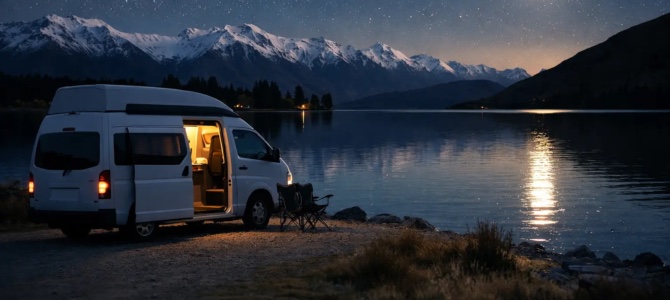
Where to Park a Van Overnight in New Zealand?
The question often comes up too late, when the sun is setting, your phone battery is draining, and no towns are appearing on the horizon. Yet, knowing exactly where to park a van overnight in New Zealand truly transforms your trip. It saves you from costly fines, unpleasant wake-up calls at dawn, and last-minute detours, especially in high-demand regions during the summer.
In New Zealand, sleeping in a van isn’t just a matter of common sense or finding a beautiful view. Rules vary depending on local councils, your vehicle type, and the specific zone where you spend the night. You can absolutely enjoy a highly flexible road trip, but that freedom works far better when you understand where you are legally allowed to park, and under what conditions.
Where Can You Park a Van Overnight in New Zealand?
The short answer is simple: in an official campsite, in certain council-authorised rest areas, or in designated freedom camping zones if your vehicle meets the required criteria. The practical answer requires a bit more nuance.
1. Holiday Parks and Managed Campgrounds
The easiest choice remains a commercial holiday park (such as Kiwi Holiday Parks or Top 10) or a managed campground. Here, you generally have access to flushing toilets, hot showers, a communal kitchen, and above all, the certainty that you are parked legally. This is the most comfortable option after a long drive or when traveling with family. The downside is the budget and, in popular areas like Queenstown, Wānaka, Abel Tasman, or the Coromandel, the necessity to book well in advance during peak season.
2. Department of Conservation (DOC) Campsites
There are also simpler campsites managed by the DOC (Department of Conservation). These are highly favored for their pristine natural settings and budget-friendly prices. However, they don't all offer the same level of facilities; some are incredibly basic, providing only long-drop toilets and non-potable water. For many travelers, they represent an excellent compromise between cost, location, and legality.
3. Freedom Camping
Finally, there is freedom camping (free camping). This is exactly where misunderstandings usually begin. Many travelers imagine they can sleep anywhere as long as they are discreet. In reality, that is not how it works. Some districts allow it only in precise demarcated bays, others ban it entirely in specific zones, and most strictly require the vehicle to be certified self-contained.
Understanding Local Council Rules
New Zealand does not have a single, uniform rule for overnight parking. Local councils define their own freedom camping bylaws with specific signage, hours, stay limits, and occasionally a maximum quota of permitted vehicles. Because of this, two beaches just a few kilometers apart can have completely different regulations.
This is why simply spotting a quiet parking lot isn't enough. A spot might look perfect yet be completely illegal for overnight stays. Conversely, a modest gravel pull-off on a secondary road might be officially authorized. The detail that matters is the on-site signage and local bylaws, not your general impression of the area.
The term self-contained is also vital to understand. Practically speaking, it designates a vehicle equipped to manage its own wastewater and sanitary needs without relying on external infrastructure. Depending on current legislation, this status remains the ultimate golden ticket to access free camping zones. If you are renting a van, it is much better to verify its certification level before booking rather than when you are searching for a spot in the dark.
Places to Avoid, Even If They Look Convenient
Supermarket car parks, immediate beachfronts, quiet residential streets, and highly popular trailhead parking lots often look like easy fixes. These are precisely the locations where compliance checks, local complaints, and strict restrictions are most frequent.
Sleeping in a van on a residential street can be poorly received by locals, even if there isn't an explicit "No Camping" sign in sight. Near major tourist attractions, overnight parking bans are common and carry significant fines. In some public lots, the rules don't just ban "camping," but explicitly prohibit any vehicle from remaining parked between specific overnight hours.
Another classic error is arriving late in an isolated area expecting to wing it. Many of New Zealand’s secondary roads are magnificent, but they do not always lead to a legal overnight site. If you leave your search to the last minute, you risk having to settle for a poor location or driving while fatigued for much longer than planned.
How to Find a Legal Spot Without Wasting Time
The best habit is to lock in your overnight spot before 4:00 PM or 5:00 PM, especially in summer. This gives you plenty of time to compare options, check the facilities, and avoid arrival stress. The travelers who enjoy van life the most are rarely the ones who improvise everything right up until sunset.
-
Step 1: Locate the standard holiday parks around your scheduled stop.
-
Step 2: Check for nearby DOC sites or officially permitted freedom camping zones.
-
Step 3: Always verify site capacity, access conditions, and toilet availability.
In certain high-demand zones, free areas are small and fill up fast. In others, unsealed gravel roads or steep gradients can make access difficult if you are driving a large motorhome.
While travel apps are incredibly useful for reading user reviews regarding noise levels or facility quality, they do not replace local signs. User feedback cannot guarantee a site's legal status today; bylaws change, sites close temporarily, and councils restrict access. On the ground, the physical sign is always the final authority.
Choosing the Right Vehicle for an Easy Night
Not all vans are equal when it comes to overnight comfort. A small campervan is easier to park and more economical to drive, but it offers less autonomy. While a compact model might be perfect for two people over a few days, its constraints become noticeable quickly on longer trips or during bad weather.
A certified self-contained vehicle opens up significantly more options and reduces the daily stress of searching for public facilities. It is often the prime choice for those wanting to mix fully equipped holiday parks with free wilderness nights. When comparing rentals, look beyond the daily price. The certification type, fresh water tank size, interior layout, and true battery autonomy matter immensely when deciding where you can sleep.
This is where local expertise comes into play. A team that truly knows New Zealand's roads, seasons, and parking habits can guide you to the right vehicle during the planning phase, rather than letting you discover its practical limitations when it's too late.
Etiquette for a Peaceful Night
Even in an authorised zone, your behavior matters. Arriving quietly, parking correctly within the designated lines, keeping your gear inside the van, and leaving the site spotless in the morning makes a genuine difference. New Zealand's regulations often tighten in areas where travelers have left a negative footprint.
Always respect basic rules regarding gray water, rubbish, and toilets. If your vehicle isn't set up for true self-sufficiency, choose an established campground with proper amenities rather than pushing the limits of a free spot. You will sleep better and avoid an uncomfortable knock on the door at dawn.
Finally, keep the weather in mind. A spectacular lakeside spot under clear skies can become miserable in heavy rain or high winds. Similarly, a highly isolated wilderness spot is less ideal if you are arriving late, have zero phone reception, or need to catch an early morning ferry. The best spot isn't always the most photogenic—it is the one that sets you up perfectly for the next day's journey.
Quick Tips for the Summer Peak Season (December to February)
-
Mix and Match: Spend a couple of nights at a holiday park to plug into power, do laundry, and empty your tanks, then alternate with basic DOC sites or permitted free zones. This holds your budget in check without turning every evening into a stressful parking hunt.
-
Book Key Nights: Secure bookings in advance for nights spent near major tourist hubs (like Queenstown or Milford Sound) or right before an inter-island ferry crossing.
The real answer to the question of where to park your van at night isn’t a magic list of secret spots. It’s a simple methodology: know the rules, choose the right vehicle for your travel style, and choose your spot before you are pressed for time. In New Zealand, this small amount of forward-planning makes the road ahead feel incredibly light.
Request a quote
|


RECEIVE OUR NEWSLETTERSubscribe today to receive ourbest offers and promotions |
STAY IN TOUCH
|
|


 info@detournz.com