






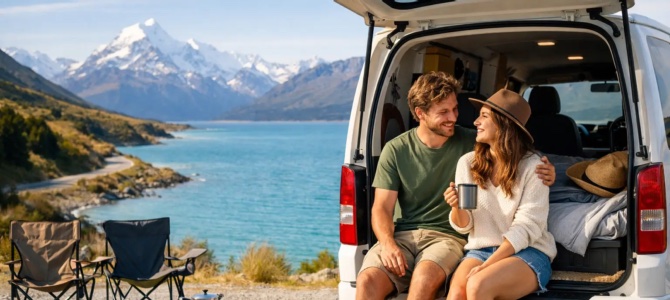
Couple's Campervan Road Trip in New Zealand
Sleeping facing a lake, cooking with the door open to the mountains, setting off at dawn without having to pack your bags again, this is exactly what makes a couple's campervan road trip so appealing in New Zealand. However, between the Instagram dream and a truly successful trip for two, there are a few crucial choices to make: the right vehicle, the right pace, the right budget, and above all, an organization tailored to living in a confined space.
New Zealand is one of the best countries in the world for this type of travel. Distances remain reasonable, the landscapes change constantly, and the campsite network allows you to travel with a great deal of freedom. On the flip side, heading out as a couple in a van does not mean completely winging it. The more realistic your initial plan, the more you will enjoy it once you are there.
Why a Couple's Van Road Trip Works So Well Here
Traveling in a van as a couple is more than just a mode of transportation; it is a way to build the trip around your own rhythm. In New Zealand, this freedom truly makes sense: you can go from a wild beach to a volcanic valley, and then to a wine region, without changing hotels every single night.
For most couples, the main advantage is simple: fewer transitions, more time together, and real flexibility. If you love a place, you stay an extra night. If the weather turns bad, you change your itinerary. If you want a slow morning with coffee and an unobstructed view, you aren't dependent on a rigid schedule or a hotel check-out time.
However, it is important to be honest about the trade-off. A van offers freedom, but not much personal space. If you both like having your own corner, or if you are traveling for a long time, your choice of vehicle becomes even more critical.
Choosing the Right Van for Two
The first instinct is often to book the cheapest model. This is not always the best decision. For two people, the real question isn't just the rental price, but your comfort over 15, 21, or 30 days.
A compact van can be enough for a short summer trip if you spend most of your time outdoors and travel light. However, for a longer journey with variable weather, it is usually better to aim for a slightly more spacious vehicle. Saving a few dollars at the start can quickly turn into fatigue if you are constantly shifting your bags, folding away the bed, or cooking in a space that is too cramped.
Key Internal Features to Check:
-
The Bed: Does the bed stay set up, or do you have to convert it every single evening?
-
Interior Height: Can you stand up comfortably inside?
-
Storage & Amenities: Look at the fridge size, storage options, and whether it includes a toilet or a shower.
Everything depends on your travel style. Some couples want to remain flexible and sleep primarily in well-equipped holiday parks. Others prefer more autonomy and a self-contained van, which is particularly useful during peak season or on highly demanded routes.
This is also where a specialised agency saves you time. Between vehicle categories, insurance options, included equipment, and varying terms between rental companies, a raw comparison is rarely straightforward. A local team capable of explaining the options clearly will often prevent you from paying more for an ill-suited van.
What Itinerary to Plan When Traveling as a Couple
The classic mistake in New Zealand is trying to see everything. On a map, distances seem short. On the road, between photo stops, winding routes, and spontaneous detours, days can quickly become too long. We frequently see travelers who schedule a late arrival at their stopover followed by an early departure the next morning, preventing them from actually visiting the location or going for a short hike.
For a couple's van road trip, the best itinerary is rarely the most ambitious one; it is the one that leaves room for spontaneity. For trips under 15 days, it is best to focus on a single island. If you have two to three weeks, you can consider a more comprehensive route, but without linking together five-hour driving legs every day.
-
The South Island heavily appeals to couples looking for grand landscapes, hiking, and a wilder atmosphere.
-
The North Island is ideal if you want to mix geothermal activities, Maori culture, beaches, and wine regions.
There is no absolute best choice. It depends on the season, your budget, and what you expect from the trip. A couple looking to alternate short walks, relaxation, and scenic drives won't follow the same route as a couple focused on adventure sports and serious trekking ("tramping," as it is called here). The right approach is to choose a few key regions and build around realistic driving times.
A Pace That Prevents Tension
When traveling as a two-person team, your pace matters almost as much as the itinerary. A succession of early alarms, long drives, and late arrivals will quickly wear on your patience. Plan lighter days with no major driving, simply to enjoy where you are.
In New Zealand, spending two or three nights in the same place is often an excellent idea. It allows you to hike, cook at a relaxed pace, do laundry, and avoid spending the entire trip setting up and packing down camp.
Budgeting for Two: Where the Real Savings Are
A van can be a very attractive option for a couple, but you shouldn't only think about the rental rate. The total budget depends on the vehicle, the season, fuel, campsites, insurance, and the ferry if you combine both islands.
The main advantage for a couple is splitting the fixed costs. The rental, petrol, and certain bookings cost less per person than they would on a solo trip. However, New Zealand is not a low-cost destination. In summer, rates rise quickly and the best vehicles get booked out early.
To keep your budget under control, it is best to book in advance, choose a well-suited vehicle rather than an oversized one, and carefully compare insurance options. This is often a misunderstood expense, yet it significantly changes the final cost. For example, the van and motorhome insurance offered by DetourNZ costs up to two times less than what the rental companies charge, which makes a real difference on a multi-week trip.
On a daily basis, cooking in the van or at the campsite helps immensely to limit expenses. You don't have to do everything yourself, though. Many couples find a great balance: handling breakfast and dinner on their own, and enjoying lunch or a restaurant meal occasionally depending on the stopover.
Living Together in a Small Space Without Stepping on Each Other's Toes
This is the topic few travelers talk about before leaving, yet it shapes the entire experience. A van brings you closer, but it also amplifies little habits. The one who wants to leave early, the one who lingers at the supermarket, the one who can't stand clutter—everything becomes more visible.
The easiest approach is to clarify a few guidelines before departing:
-
Who will drive most frequently?
-
Who will manage the groceries?
-
Will we book certain campsites in advance or not?
-
What level of comfort is absolutely non-negotiable?
Sorting out these details avoids a lot of frustration. It is also helpful to accept that a successful trip doesn't mean doing everything perfectly in sync. Everyone needs a moment to themselves, even in a romantic setting. A solo walk, reading at the campsite, or an hour of driving in silence is sometimes exactly what maintains a great energy over the long haul.
Small Equipment That Truly Changes the Trip
Certain accessories might seem secondary when booking, but they become essential on the ground. A good outdoor table, two genuinely comfortable chairs, proper bed linens, quality towels, and a well-thought-out storage space make daily life much more enjoyable.
Also, think about connectivity and charging your devices, especially if you use your phone for navigation, bookings, or weather updates. And if you are traveling off-season, the question of heating should never be treated as a minor detail.
Campsites, Freedom, and Local Rules
New Zealand is incredibly welcoming to van travel, but this freedom comes with rules. You cannot park overnight just anywhere. Regulations of Self Contained vary by zone, and self-contained vehicles have more options in certain regions.
This does not mean you need to book everything months in advance. However, during the high season in popular spots, planning your most important nights avoids stressful ends to your days. For a couple, arriving late and searching for a campsite after several hours on the road quickly takes away from the fun.
Kiwi holiday parks or Top 10 holiday parks are often highly practical for two, especially if you want a hot shower, a communal kitchen, laundry facilities, and sometimes a bit more space. Simpler campsites work beautifully too if you are self-sufficient. Again, it all depends on the level of comfort you are looking for.
The Best Season to Depart as a Couple
Summer naturally draws people with its long days and milder temperatures. It is also the most expensive and highly demanded period. For many couples, the shoulder seasons offer a better balance. Spring and autumn often allow you to travel with fewer crowds, more reasonable rates, and a quieter atmosphere at the campsites.
In winter, traveling is still possible, particularly in certain regions, but it requires a well-suited vehicle and an itinerary planned around the conditions. It isn't necessarily the best option for a first-time van experience if you want a simple, relaxed trip.
What makes a road trip for two in New Zealand successful isn't just the backdrop. It is the feeling of moving forward together without rushing, with a well-chosen vehicle, a realistic itinerary, and enough leeway to improvise when a place makes you want to stay just a little bit longer.
Request a quote
|


RECEIVE OUR NEWSLETTERSubscribe today to receive ourbest offers and promotions |
STAY IN TOUCH
|
|


 info@detournz.com