






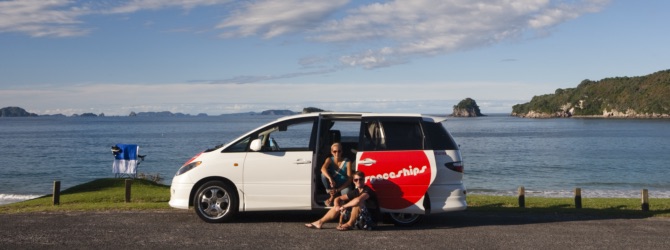
Campervan Rental Auckland, New Zealand
Landing in Auckland after a long flight and picking up your vehicle on the same day is often where the journey truly begins. A good campervan rental in Auckland, New Zealand, is about more than just the displayed price. Choosing the right van will determine your comfort on the road, your fuel budget, your freedom to park, and very practically, the overall quality of your stay in New Zealand.
For most travelers, Auckland is the easiest starting point. The city offers a large selection of rental companies, easy transfers from the airport, and convenient departures toward Northland, the Coromandel Peninsula, Rotorua, or, further afield, the center of the North Island. Above all, it is simply where you arrive.
Why Choose Auckland to Rent a Campervan
Auckland simply offers the widest range of vehicles in New Zealand. Whether you are looking for a small van for a couple, a compact campervan with a shower, or a more spacious family model, this is generally where you will find the most options and the best price differences. This competition works in your favor, provided you compare what is actually included.
The other advantage is logistics. Many international travelers arrive in Auckland, spend a night in a hotel to recover from jet lag, and then pick up their van the following morning. This is an excellent approach, especially in New Zealand where you drive on the left and distances often look shorter on the map than they actually are.
However, there is another perspective to consider. If you are nervous about driving on the other side of the road, or if you want to drop off the van and depart immediately at the end of your trip, starting right away in the South Island is a great alternative. Indeed, the roads are much quieter in the South Island, and for the vehicle return, you just drop it off and go straight to the airport for your international flight. You can also enjoy Auckland for a few days at the end of your stay. Additionally, it is worth noting that prices starting from Christchurch are sometimes cheaper.
Campervan Rental Auckland New Zealand – Which Vehicle to Choose?
The right vehicle depends less on the dream of a road trip and more on your actual style of travel. Many travelers book vehicles that are too large out of fear of lacking comfort, only to regret having a more expensive, less fuel-efficient vehicle that is harder to park. Others do the opposite and find themselves living for several weeks in an overly cramped space.
For a couple planning short driving legs and a few nights at fully equipped campsites, a compact campervan is often the best compromise. It remains easier to drive, consumes less fuel, and allows you to travel and stop easily. If you are traveling in winter, or if you plan a long trip with many nights spent onboard, a larger model with a proper indoor kitchen and independent heating can make a world of difference.
For a family, you need to look beyond the number of berths. Storage space, ease of setting up meals, nighttime access to the toilet, and the time required to convert the beds matter just as much as the overall size of the vehicle. On a three-week itinerary or longer, these details quickly become crucial. For example, a 6-berth motorhome for a family of four allows you to have a table always available without having to convert it into a bed every evening.
The "self-contained" status also deserves your attention. In New Zealand, this point influences parking options and certain camping experiences. Not all travelers need it, but if you want more flexibility outside of traditional campsites, it is often a priority criterion.
What the Price Actually Includes
This is where superficial comparisons become misleading. Two offers can look very similar, but then reveal a distinct difference once you add insurance, bedding, certain equipment, child seats, drop-off fees, or costs for an additional driver.
The best price is not simply the lowest daily rate. You have to look at the total cost of the trip. Some rentals include more basic equipment, while others have high insurance excesses (deductibles) or less flexible modification policies.
One-way fees also warrant a double-check. Some rental companies are located close to the airport and offer shuttles, while others are outside the airport zone and do not provide a shuttle service. This isn't necessarily a dealbreaker, but after a long-haul flight, it matters.
When to Book to Pay Less
In this market, waiting does not always help. During the New Zealand summer, from December to February, the most popular vans sell out early, and so do the best rates. To travel during this period, booking several months in advance remains the safest solution if you want both choice and a controlled budget.
The shoulder seasons, such as October–November or March–April, often offer an excellent balance. Rates can be softer, roads are less crowded, and the weather is frequently still favorable. For many travelers, this is the most enjoyable time to discover the country in a van without dealing with peak crowds.
In winter, prices can be very attractive, but you must adjust your expectations. The days are shorter, some regions are colder than you might think, and a well-equipped vehicle becomes essential. Saving on the rental rate only to lack thermal comfort is not always a good deal.
Frequent Mistakes to Avoid Before Booking
The first mistake is underestimating distances. From Auckland, it is tempting to stack the Bay of Islands, Hobbiton, Rotorua, Tongariro, and Wellington into just a few days. On paper, it looks doable. In reality, a successful road trip in New Zealand relies on a reasonable pace. You should factor in an average speed of about 60 km/h for your journey.
The second mistake is choosing a van based solely on photos. A layout might look beautifully designed but turn out to be impractical depending on your height, your travel season, or your need for autonomy. It is better to check bed lengths, storage capacity, kitchen equipment, and the presence of a heater if necessary.
Another frequently overlooked point is insurance. Many travelers only look at the basic excess when they pay. Yet, it is the detailed terms that truly matter—windscreens, tyres, underbody damage, unauthorized roads, assistance for flat batteries, or misfueling errors. More comprehensive coverage costs more, but it can prevent a very nasty surprise. Our Camper Cover insurance is often cited as a better alternative.
Where to Go After Auckland in a Campervan?
-
If you have about a week: The area north of Auckland works very well. The beaches of Northland, the Bay of Islands, and the kauri forests offer an excellent introduction without multiplying long days on the road. This is a reassuring option for a short stay or for travelers who want to stick to a straightforward itinerary.
-
With ten to fourteen days: A loop toward the Coromandel, Hobbiton, Rotorua, and Taupo is often more balanced. You alternate between coastlines, geothermal springs, lakes, villages, and activities, all while keeping distances realistic. This type of route suits those who want to see a lot of scenery without turning the trip into a marathon.
-
For a longer stay of 3 weeks or more: Auckland can be the starting point for a complete crossing down to Wellington, and then over to the South Island. In this case, you need to think very early about availability, the ferry, and potential drop-off fees in another city. This is where reliable support makes a real difference. At DetourNZ, this is precisely the benefit of comparing vehicles with a genuine itinerary logic, not just a price chart.
The Right Approach for a Stress-Free Booking
Renting a campervan in Auckland, New Zealand, becomes much simpler when you start from your actual needs. How many people are traveling, in which season, with what level of comfort, for how many days, and with what kind of self-sufficiency? From there, it is easier to weed out unsuitable options and spot the true good deals.
Look for a clear price, with no useless booking fees, a good selection of vehicles, and support capable of answering your questions both before departure and during the trip. The travelers who save the most are not always those who take the cheapest offer. They are often those who book the right vehicle, at the right time, with the right guarantees.
If you are preparing for a road trip in New Zealand, take the time to properly choose your starting point, your van category, and your level of coverage. The rest of the trip will be smoother, freer, and much more enjoyable right from the very first kilometer.

Request a quote
|


RECEIVE OUR NEWSLETTERSubscribe today to receive ourbest offers and promotions |
STAY IN TOUCH
|
|


 info@detournz.com